
An Immigrant's Journey

On December 23, 1884, my great grandfather Julius Friedlaender (father of my grandmother Irma whom I wrote about here) arrived in New York after a 16 day trip in third class aboard the steamship, Gellert, from Hamburg, Germany. The fourth child (and third son) of Marcus Friedlaender and Minna Hirsch, he had left his home in the town of Thorn in West Prussia (now known as Torun in Poland). I don’t know what his father’s line of work had been, only that he had died suddenly of a heart attack. So perhaps the best course of action for a young man at that time was to seek opportunity in America, particularly since a few relatives had already made the leap.
For all the anti immigrant Americans now claiming that their ancestors arrived in the U.S. “the right way,” it’s worth considering what that meant in 1884. If you weren’t Chinese (who were deliberately excluded in a series of laws enacted beginning in 1882), the terms were simple. The ship transporting immigrants had to pay federal authorities 50 cents a head and the only other restriction was that you couldn’t be “a lunatic, convict, idiot, or person unable to take care of himself without becoming a public charge.” Ellis Island did not exist. Restrictions related to health, language, and national origin (again, other than those from China) had not yet been enacted.
So Julius Friedlaender at age 23 with $30 in his pocket (about $1,000 in today’s dollars) simply stepped off the boat and made his way on a streetcar to the home of his Aunt Yetta Asher on Sixth Avenue. She was apparently a welcome host, providing a bed for two nights and a cardboard box filled with “bread, eggs, meats, sausages, and whatnots” to sustain him on his onward journey. (The quotations come from my grandmother’s transcription of his story, related to her in 1929.)
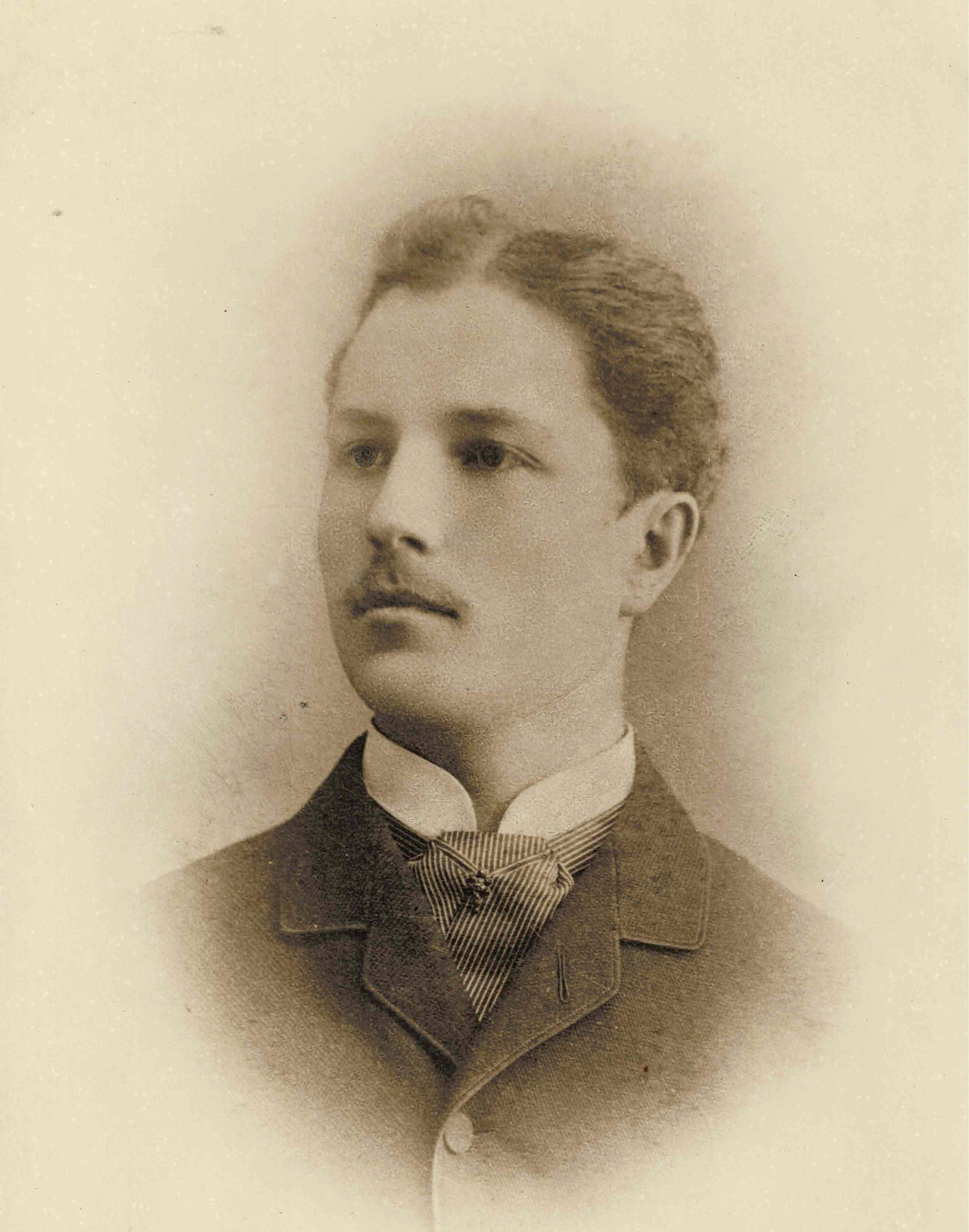
The next part of the adventure was to get a train ticket to Macon, Georgia where his sister Rosa had settled after making the same voyage on the Gellert five years earlier. At the ticket office, he was told that the fare would be $35. But having been told back home by the steamship agent that it would be only $15, he persisted and went to another ticket office where he was able to secure an “immigrant fare” of $15 and a ticket some 3 yards long.
He boarded the train in New York, bearing his cardboard box and a fur coat (a small trunk having been checked) and set off on the long journey south. With the help of various kindly strangers (for although having studied German, Latin, Greek and French in high school, his English was quite limited), he went first to Philadelphia where he changed trains headed for Harrisburg, Pennsylvania. Some six or seven changes later, he arrived in Dalton, Georgia, his ticket having become progressively smaller as conductors clipped off a portion for each leg. After an overnight stop sleeping in the waiting room of the train station, he went on to Atlanta and then finally to Macon. “I was now in a coach that had seen years of service,” he told his daughter. “I remember there was a hole in the floor, and it was smelly and dirty.” I imagine that he might have been pretty dirty himself at that point.
Upon arriving in Macon, he began wandering in search of the home of his sister and her husband Philip Berg. When finally locating the house, he found that they were not there, only some strange woman who could not understand a word he said. He set off once again and by some miracle, he ran into Philip’s brother who not only spoke German but also knew that Julius was en route. He took him to Mulberry Street where the Bergs had moved some months earlier, living above the clothing store they operated. Finally his journey was at an end. Or at least for the time being.
By 1889, Julius had moved to Columbus, Georgia where he found employment first with his uncle who owned a barrel factory and then becoming a business owner himself with an eponymous company that manufactured jute bagging for bales of cotton.
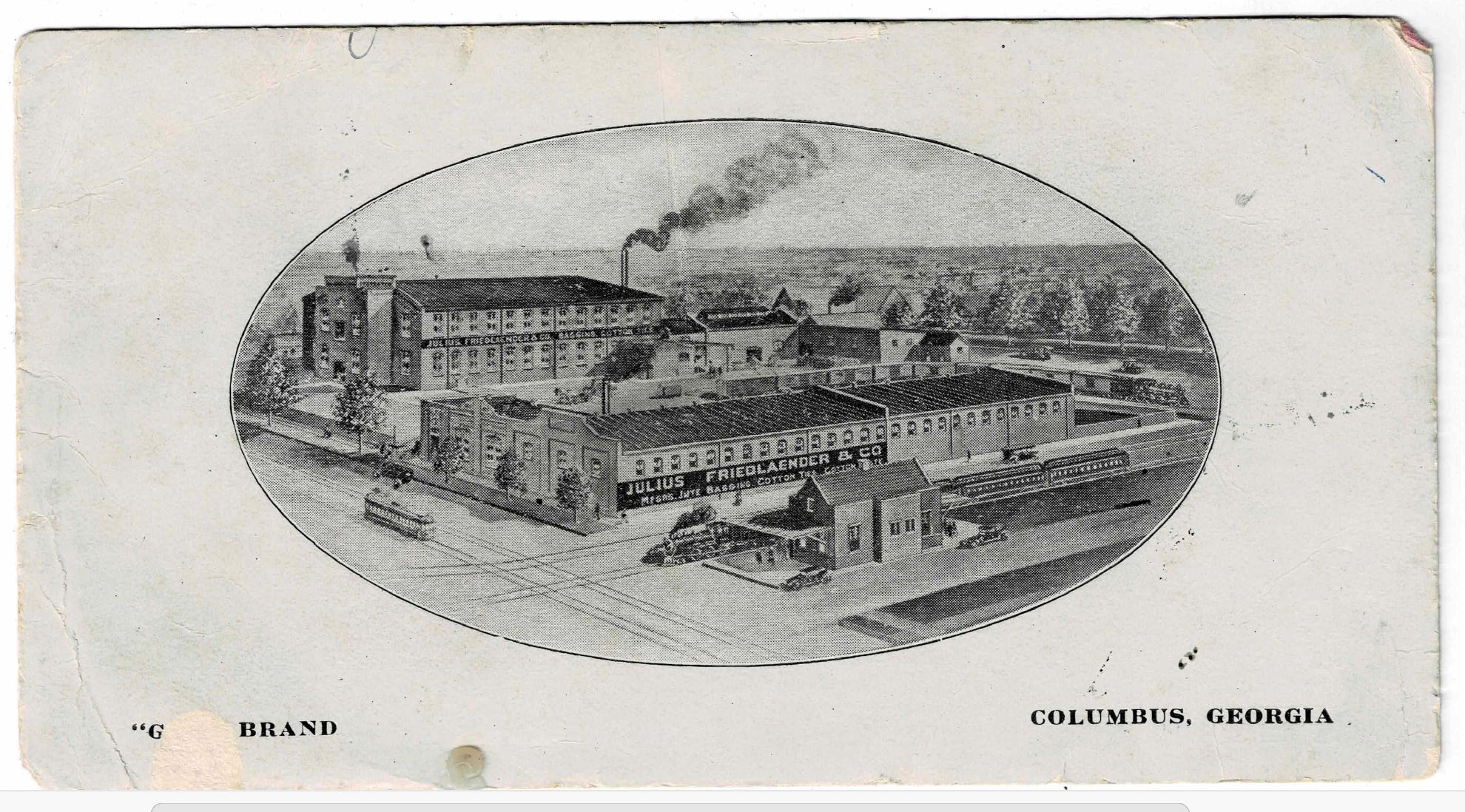
In 1895, he married into a family of prosperous German Jews who had arrived in the 1840s; my grandmother arrived a year later. His business thrived, providing a comfortable life for his immediate family and descendants. He travelled back to Thorn several times to see his family and eventually became a U.S. citizen in August 1907, renouncing any allegiance to the emperor of Germany and swearing that he was neither an anarchist nor a polygamist. His only son was not interested in the jute bagging business so after his death in 1932, management of the company was passed along to cousins who kept the business going into the 1990s.
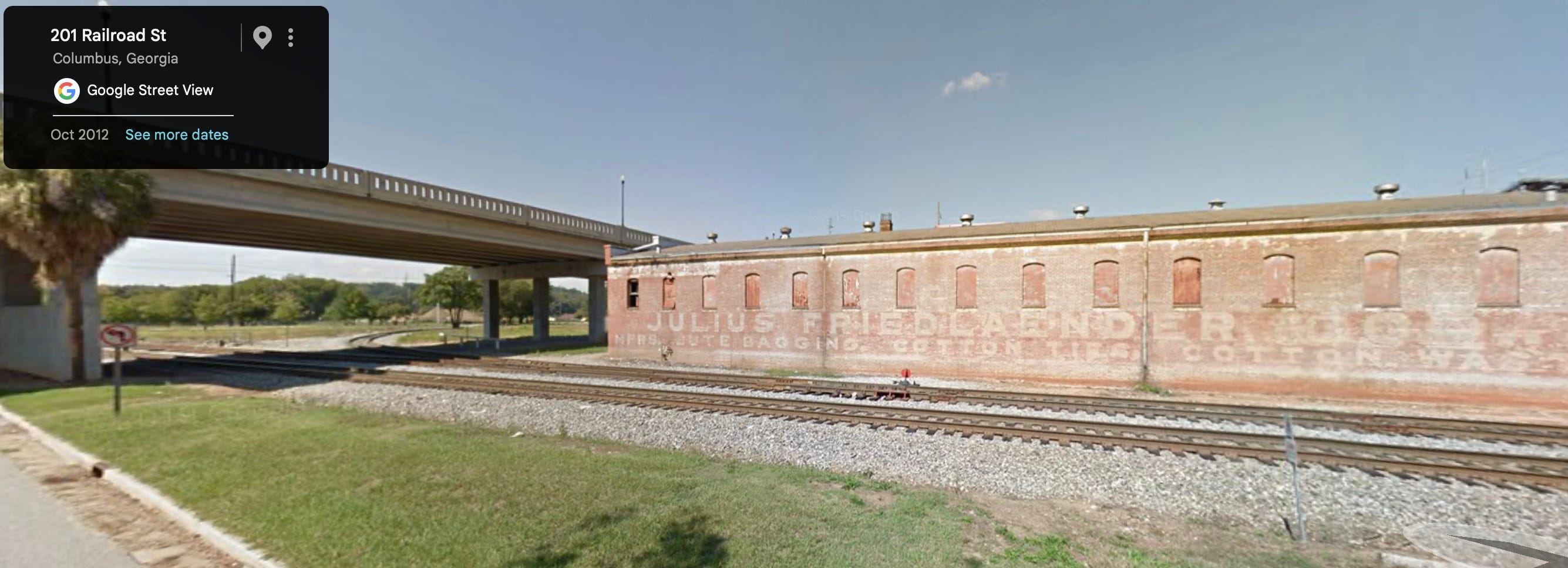
The image below, captured by Google Maps in 2012, is the only physical reminder of Julius Friedlaender’s journey, the family home having been razed and replaced by a multistory office building. You can just barely make out the company name on the side of the abandoned mill. I haven’t been to Columbus since I was a little kid, so who knows if this building is still standing.
So what to make of all this now? Mostly, I feel fortunate to have this account of pluck, determination, and plain old good luck, particularly since the coming-to-America stories of my other forebears have either been lost or are full of contradictory information. I guess in the end, my siblings, cousins, and I are the true legacy of his immigrant journey. And what could be more American than that?
love this, Anne! thanks for sharing!
Love to read these kinds of stories. Thank you.