
The Settlement Cook Book
Combining two of my interests: cooking and social history

When we renovated our kitchen ten years ago, I didn’t want a farmhouse sink, a marble counter top, a hot water pot filler or any of the other fancy doodads that kitchen designers push. What I really wanted (beyond replacing the dated tile work and falling apart cabinets) was a dedicated shelf for cookbooks. And I didn’t want a library’s worth of shelving. Just 44 inches was what I had in mind.
That meant that I had to cull the collection of cookbooks that I’d amassed over the years. Out went the beautifully photographed volumes whose recipes never turned out remotely like the pictures. Ditto the one from my favorite upscale restaurant which promised delicious dishes that I couldn’t reproduce. With the passage of time, the acquisition of new cookbooks has required a considered decision about what must go to make room.
One book I couldn’t throw out was this tattered copy of The Settlement Cook Book, given to my parents as a wedding present in 1956 from “Miss Myrtle,” who was a friend of my grandmother. It was a thoughtful gift given that my mother had never put a full dinner on the table before she married and my dad’s culinary repertoire never got much beyond cheese sandwiches and a yearly birthday cake for my mother that he made from a mix.
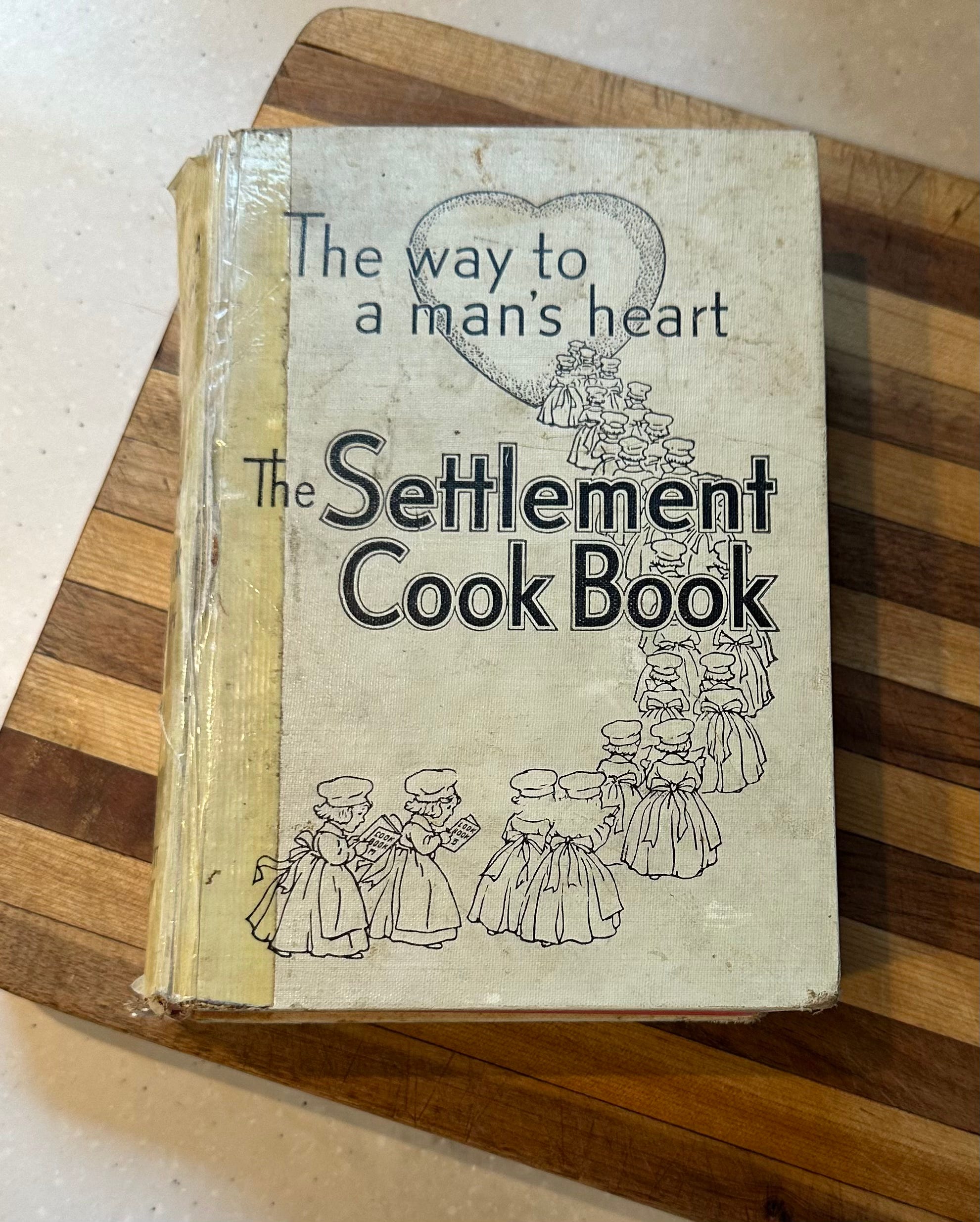
The first edition of The Settlement Cook Book was published in 1901 in Milwaukee, and was designed to help immigrant cooks adapt to the culinary ways of their new home. Its primary audience were Jewish families arriving from Eastern Europe resulting in a weird mishmash of both traditional Jewish favorites and an odd assortment of decidedly non-Kosher recipes. In my 1951 edition, you get such delights as “frog legs, fried,” “asparagus ring,” “pickled herring with cream,” and “Sabbath twists (Cholla).”
I love this recipe for bacon, clearly for Jewish ladies who had never attempted it before:
Place bacon, from which the rind has been removed, in a cold frying pan, heat slowly until crisp. Press fat from slices with broad knife to prevent curling. Turn occasionally….Or place bacon in a hot frying pan, reduce heat.
The book also includes chapters describing household rules and kitchen equipment, canning, camp cookery, and menus for every occasion from home dinners to cocktail parties with holiday themes including both Christmas and Passover. The 1951 edition includes a chapter on the feeding infants and children written by my grandfather who at that time had a part-time appointment in the Department of Pediatrics at Marquette University Medical School.
The last edition of the book came out in 1991 by which time there were relatively few newly arriving Jewish immigrants who needed a cook book to help them assimilate. The evolution is nicely described in this article on the Taste web site. The older versions are now collectors items. I found one 1951 edition in worse shape than mine going for over $200! Other book sellers are offering them in a more reasonable $20 to $40 range.
To be honest, I only pull out The Settlement Cook Book occasionally. Its pages fall open to the recipe for potato latkes which I cook every year for Hannukah, having learned to ignore the advice to use 1.5 teaspoons of salt for every 2 potatoes. In the spring, it comes out again for Passover, the only time of the year when I make matzo balls. Again — too much salt. There is also a kind of recipe for charoses, another seder must, but that’s one of the few things I can make just by taste. But it’s a treat to see my mom’s handwriting in the margins and I will never throw out her planning notes scribbled on slips of paper tucked between the pages.
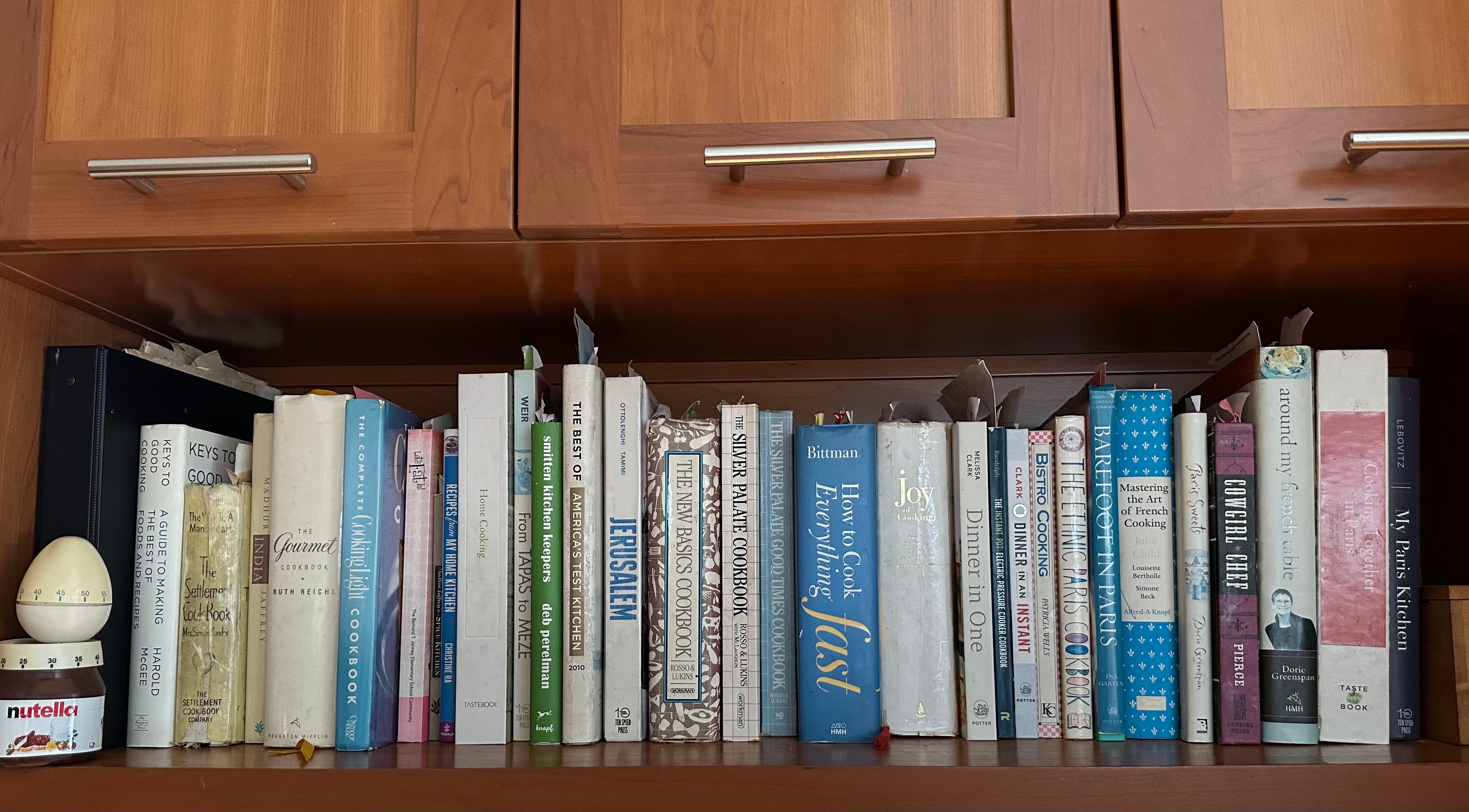
Here’s my cookbook collection as it currently stands. See any of your favorite here? Don’t tell me what’s missing. I haven’t the heart right now to throw out any of these to make room.
My “New Basics” is in tatters, but I could never get rid of it, if only for the Kathleen’s Devil’s Food Cake that has been our family’s birthday go-to, since my kids (now parents themselves) were tiny.
That Nutella timer is incredible! I see Bittman, Smitten Kitchen, and ATK represented which probably accounts for 75% of our household's recipe sourcing.