
The Interior Museum
Here's one Washington attraction I bet you never knew about

Back in 2019 when I was working on Medicaid policy, a colleague and I were asked to come brief folks at the Office of Insular Affairs at the U.S. Department of the Interior who are responsible for various federal programs in the U.S. territories. In the niche of Medicaid financing and administration policy, we had even niche-ier expertise to share about how the Medicaid program operates in American Samoa, Guam, the Commonwealth of the Northern Mariana Islands, and the U.S. Virgin Islands. (For reasons I can’t recall now, that office does not deal with Puerto Rico which is the biggest U.S. territory by geography, population, and the size of its Medicaid program.) On our way to a conference room, we passed by some interesting wall murals and were invited to come back another time for a proper tour of the art work and the department’s museum. Then the pandemic happened and most federal buildings closed. My colleague (who was really the brains on this issue) moved onto another job. I retired. So we never took those folks up on their offer.
But you don’t need a special offer from Interior Department employees as the museum is open to the public and you only need an advance reservation if you want to take a guided tour. To be completely transparent, despite the fact that the department has pretty vast collections of Native American artifacts and treasures from the natural world, the small exhibition galleries are not particularly noteworthy. In fact, I’d call them skippable. But the tour is totally worth the price of admission which admittedly is free. The building’s walls are the canvas for over 40 New Deal era murals, apparently more Public Works Administration (PWA) artwork than in any other federal building with the second most PWA artists represented. It’s noteworthy that the public can still enjoy these works of art. Those of a similar vintage by artist Ben Shahn in the Wilbur Cohen Building which houses parts of the U.S. Department of Health and Human Services are not open to the public; that building has been listed for sale by the U.S. General Services Administration, making the future of those murals unclear.
But back to Interior. There are heroic images of American workers building things.


And yes some fairly eyebrow-raising depictions of westward expansion and relationships between the white man and indigenous people. The two directly below are the work of Maynard Dixon, a renowned painter of the American West, who was at one time married to photographer Dorothea Lange. The scene below these is by John Steuart Curry, a Kansan considered one of the three top American regionalist painters alongside Grant Wood and Thomas Hart Benton.


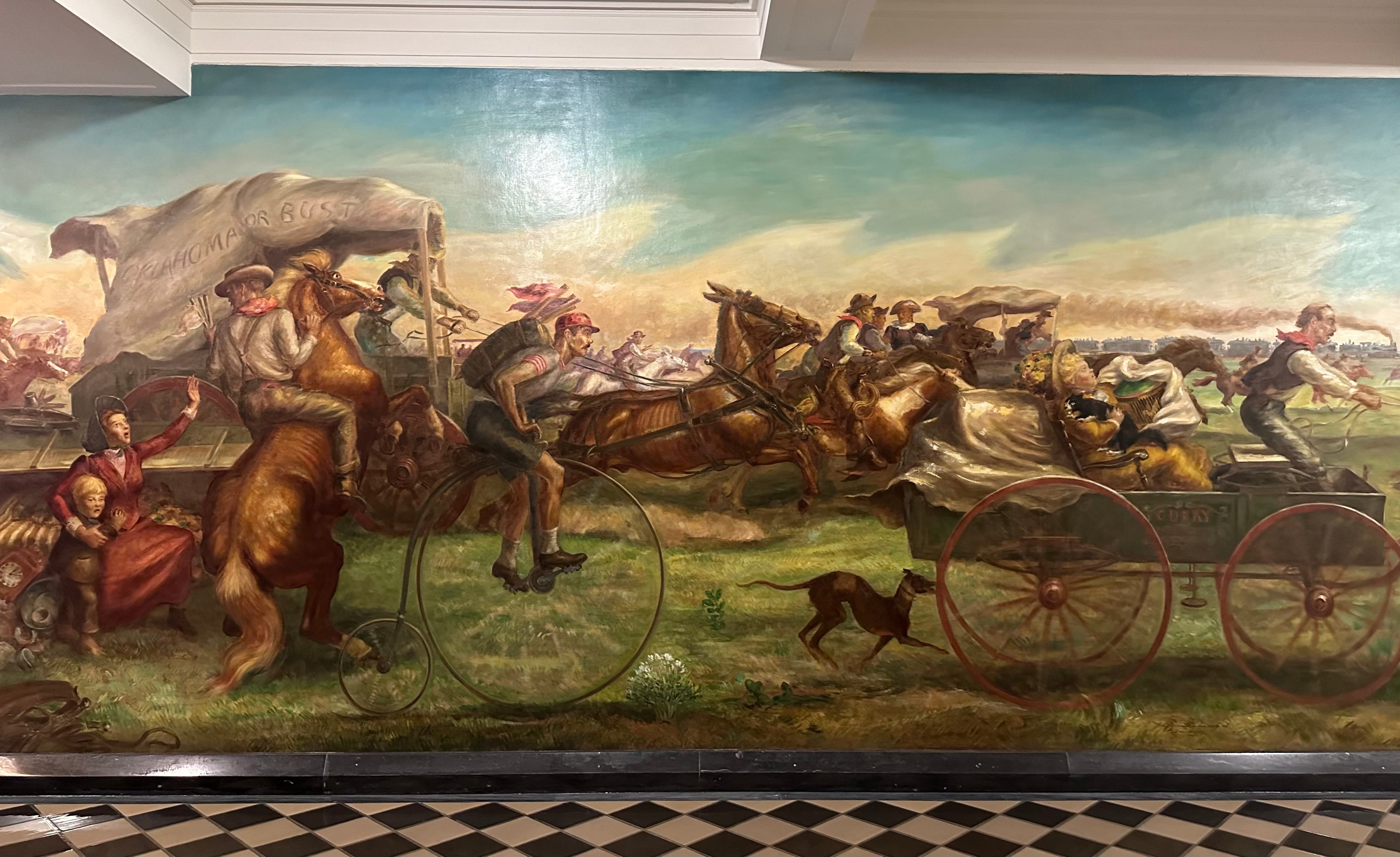
There are some interesting architectural and design flourishes, a nice change from the typical institutional beige or pale green you’d find in most office buildings of this vintage. In addition, there are large format prints by landscape photographer Ansel Adams lining several hallways but I didn’t take any pictures of those.


It’s also important to remember the context when the building was erected in 1935-36. The national economy had collapsed and millions were out of work. Federal agencies were stood up to build roads and bridges, hospitals and schools, swimming pools and ice skating rinks. They brought electricity to rural communities and invested in agricultural improvements And the powers that be also said “yes, we should employ artists: painters, writers, photographers, filmmakers.” It’s frankly unimaginable today.
The Interior Museum is in the Stewart Lee Udall Department of the Interior Building at 1849 C Street, NW. The museum is open Monday through Friday from 9 am to 5 pm. Tours are given on Tuesdays and Thursdays at 2 pm. You must reserve in advance by calling 202 208 4743. Be patient as you may have to call multiple times before you get a human being.
I had no idea thank you!