
The Einstein Memorial
Monumental and yet intimate

I went down to the National Mall a few weeks back looking for the golden toilet that some guerrilla artists with an actual National Park Service permit had installed in front of the Lincoln Memorial. You won’t need three guesses to determine whose throne it was meant to be.
But I was several days too late. The art installation was gone without a trace. The tourists were busy buying ice cream and snapping photos in every direction, and I wandered off in search of another source of inspiration. The Lincoln Memorial, the Vietnam Veterans Memorial, the construction of a new memorial honoring those who died in Operation Desert Storm and Desert Shield — none of it lit a spark. But then there he was, Albert Einstein, sleepy eyed, disheveled, posed sitting on a short flight of steps engraved with his words: “As long as I have any choice in the matter, I shall live only in a country where civil liberty, tolerance, and equality of all citizens before the law prevail.”
Oh Albert. Or should I more respectfully say, Oh Dr. Einstein.
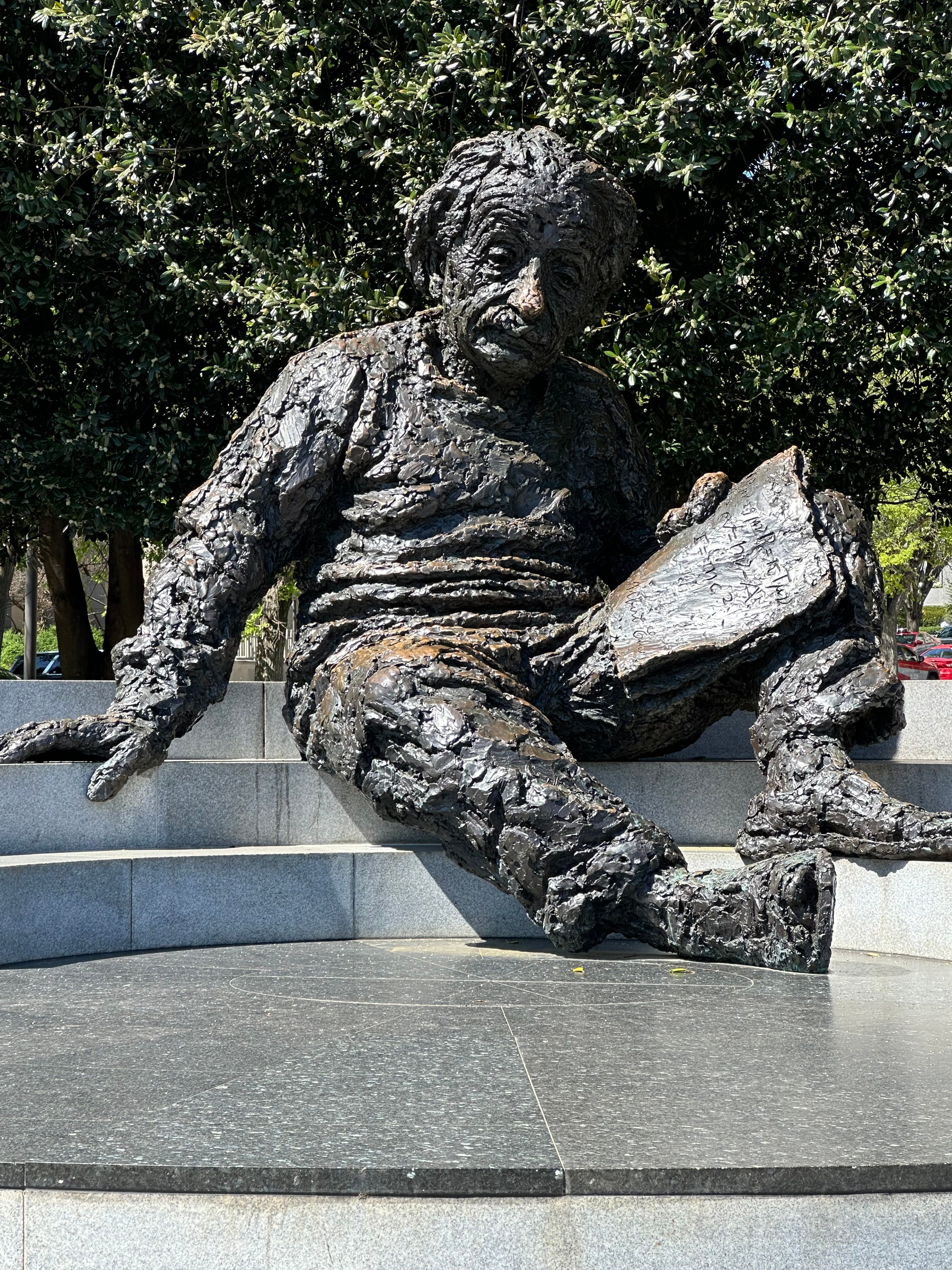
The Albert Einstein statute was installed in 1979 in front of the National Academy of Sciences, a private nongovernmental institution that frequently convenes scientists from various disciplines to advise policymakers on important issues of science and technology. The occasion was the centennial of Einstein’s birth and the purpose to honor both his scientific breakthroughs — the photoelectric effect, the theory of general relativity, and the equivalence of energy and matter — and his humanity. Einstein famously regretted that his work led to development of the atom bomb, its destructive uses in World War II, and the ensuring international arms race. His later years were dedicated to advocating for nuclear disarmament.
It’s not uncommon to find a kid sitting in Einstein’s lap for a photo (hence the discoloration in that area of the statue) but none were around on my visit so you’ll have to imagine the scale. The figure is 12 feet high and weighs 4 tons. If the texture brings to mind the gigantic bust of John F. Kennedy in the foyer of the Kennedy Center (which, I believe, is still there although I haven’t been inside in months), the association is apt. Both are the work of Robert Berks who sculpted Einstein from life in 1953. Other Berks works depict Mary McLeod Bethune, Robert F. Kennedy, Carl Linneaus, Abraham Lincoln, and Fred Rogers.
The small stone plaza in front of the sculpture is embedded with more than 2,700 metal studs that represent the planets, sun, moon, stars, and other celestial objects as they would have appeared in the sky on the dedication date. I couldn’t capture it very well with my phone, meaning that you’ll just have to stop by to check it out for yourself.
The Einstein Memorial can be found on the northeast corner of Constitution Avenue and 22nd Streets NW. It’s a bit of a schlep from the Foggy Bottom Metro but within steps of other memorials and monuments (see above) well worth your time.
Love this memorial
its one of the few memorials in DC that encourages kids to interact with it, touch and sit. As Anne pointed out the metal stud pattern was the sky on the day of the dedication which would have been his 100th birthday.