
Freedom Plaza
A curious renovation honoring the spirit of 1776

One of the funniest words in French is “relooking.” It means exactly what you might think — a makeover or restyling, usually used for real estate. Protectors of the French language utterly failed in preventing this word from entering the lexicon, hilarious to me because while it is English inspired, it has no real meaning in English.
Relooking, however, perfectly encapsulates what has happened at Freedom Plaza at 14th and Pennsylvania Avenue NW. The fences and tarps came down sometime in June with an official unveiling on June 30th. And it is both worse and more confusing than what I had previously surmised. The plaza is now lined with 12 statues of Revolutionary War figures, anchored by the equestrian statue of Caesar Rodney and a classically attired woman holding a sword aloft. In the space behind Rodney, there is a set of bronze reliefs on plinths to commemorate the Americans who were held as prisoners on British ships during the Revolutionary War. The whole ensemble, dubbed “The Spirit of ‘76” is said to be temporary but I can’t find any information on how long it will be in place.
I’ve got nothing more to say about the Rodney statue but let’s unpack the rest. The National Park Service describes the 12 statues being “rendered in historically-grounded poses and attire, emphasizing the diversity of roles, backgrounds, and sacrifices that defined the Continental Army and American militia forces.” Leaving aside what a “historically grounded pose” might be, each statue stands on a pillar identifying the occupant and a few details about his role in the war. I guess I should give props here for diversity (half of those depicted were African American) since the Trump Administration seems otherwise allergic to this concept as a strength.
Curiously, several of the statutes which were gilded when I visited in late May are now completely black. I spent way too much time sleuthing online since I know nothing about metallurgy and it appears that raw bronze can have a golden color that may be treated chemically to achieve the flat black you see here. But I’m still puzzled as to why the artist wouldn’t do that in the studio rather than applying the final color on site. But what do I know?


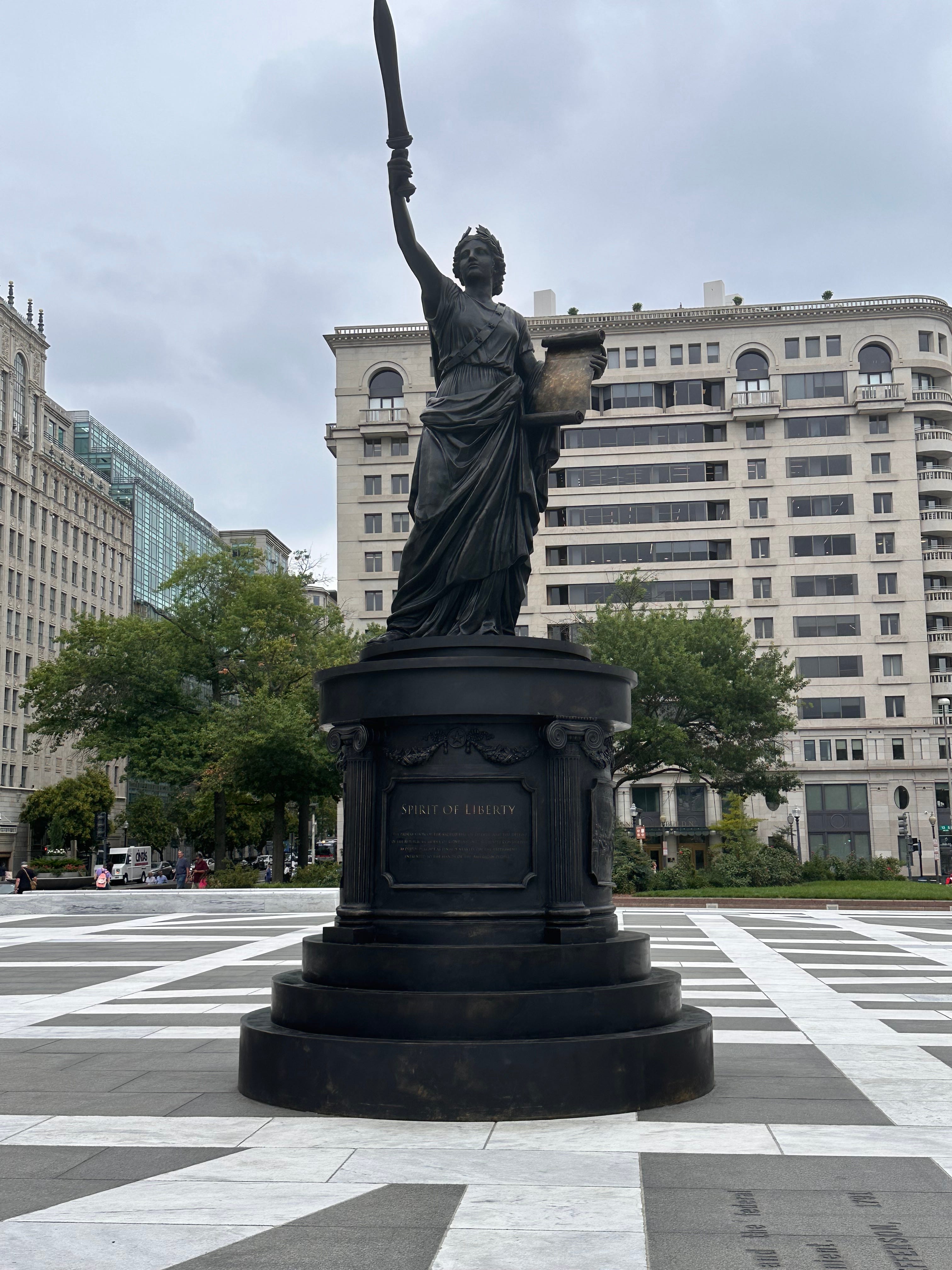
Moving on, we come to the 23 foot high “Spirit of Liberty” who holds the Declaration of Independence. The base bears the text: “the preservation of the sacred fire of liberty, and the destiny of the Republican model of Government, are justly considered as deeply, perhaps as finally staked, on the experiment entrusted to the hands of the American people.” A little Googling allowed me to identify that this sentence comes from George Washington’s first inaugural address, a fact that you’d think would be worthy of mention on the plaque itself. The artist (or artists) of these works is not identified on site or in any of the descriptions on the NPS website.
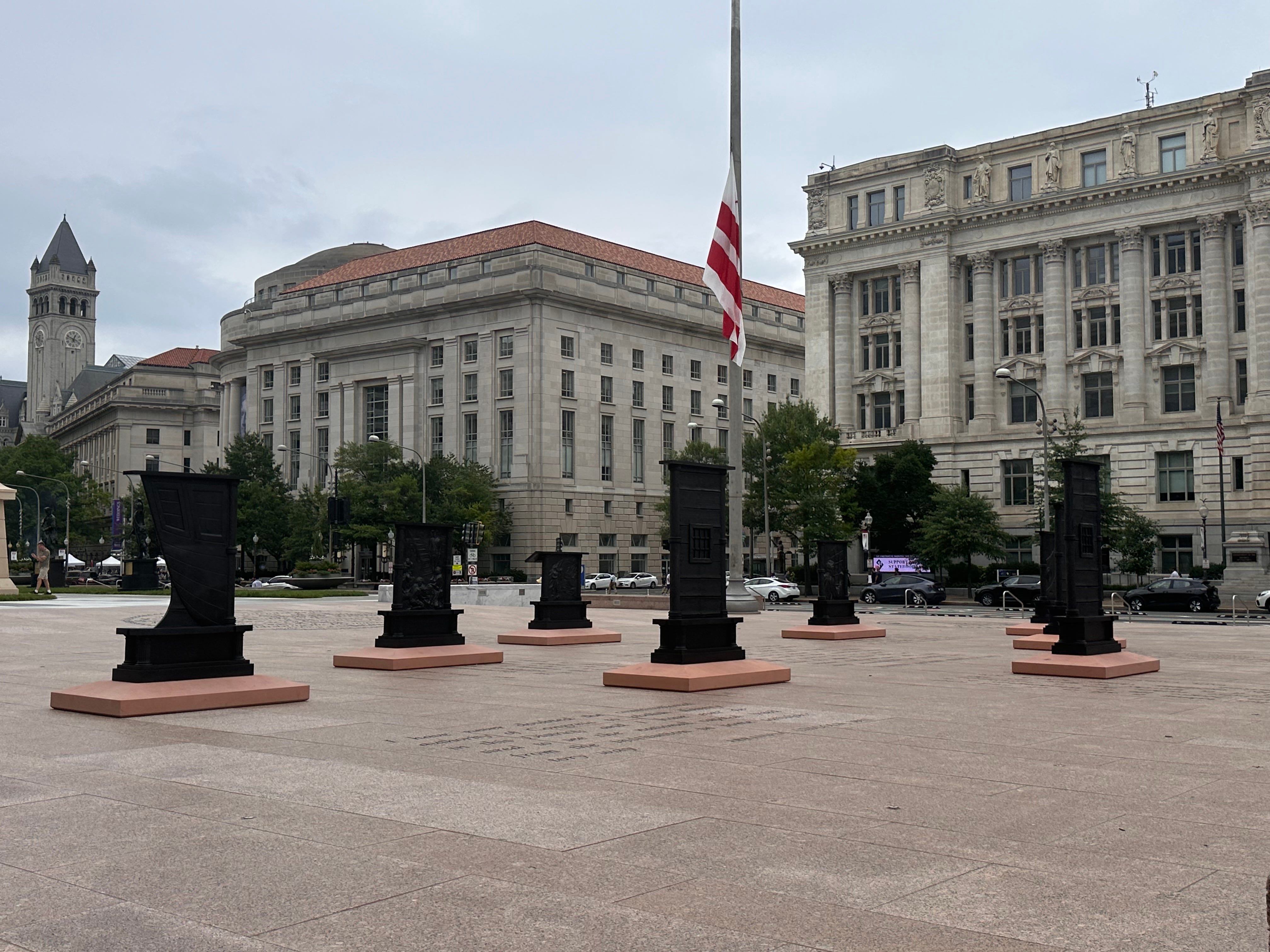
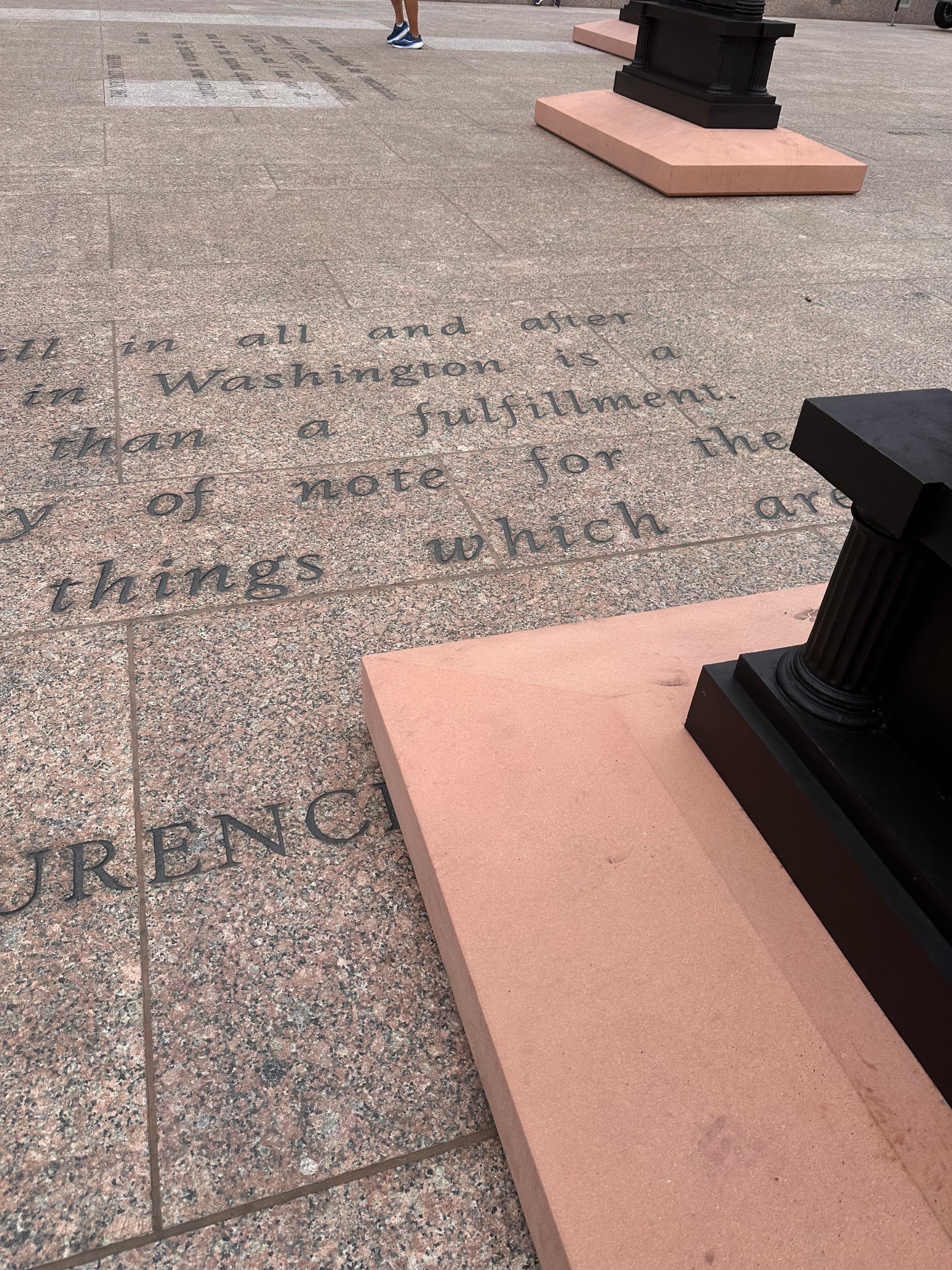
And then we come to the reliefs that memorialize the 11,500 Americans who died on 16 British prison ships, which the DC Council’s Instagram site called giant pieces from the board game Stratego These are placed on the plaza in the form of a ship (although I only know that from the website) and in some cases, the plinths obscure the quotations engraved in the plaza itself. There is one descriptive plaque but again no mention of the artist.
This is a piece of the Revolutionary War story that I was not familiar with until I watched Ken Burns’ recent documentary series, but it certainly cannot be said to be forgotten. A substantial monument to these men, designed by noted architect Stanford White, can be found in Fort Greene, Brooklyn where it has stood since 1908. But that property is maintained by the city of New York which we know is now run by Communists (amirite?). Curiously the NPS description of the Freedom Plaza monument includes a photo of the Fort Greene site but otherwise does not mention it.
So there you have it: a mishmash of poorly explained and sourced statuary that confuses as much as it purports to inspire. Plus, it’s kind of ugly. Your tax dollars at work.
Love your art critiques and wish you were viewing them somewhere far away from here. Whoever did this clearly has no aesthetic taste. Thank you for your sleuthing and good taste.
So, many questions. Such as: whose taxes are paying for these, forgive the term, erections? (Federal taxpayers or DC taxpayers?) And where do they stand on the map of Peter L”Enfant’s map of the District that fills the Square?